
Celsius vs Fahrenheit: History, Who Still Uses °F, and Exact Conversions
Most weather forecasts in the world are given in degrees Celsius. A handful of places, led by the United States, still use Fahrenheit. If you travel, follow American news or compare cities on a weather app, you will meet both. This guide covers where each scale came from, which countries still use Fahrenheit, the exact conversion formulas, and the mental shortcut most people use, including how far wrong it goes.
Where the two scales came from
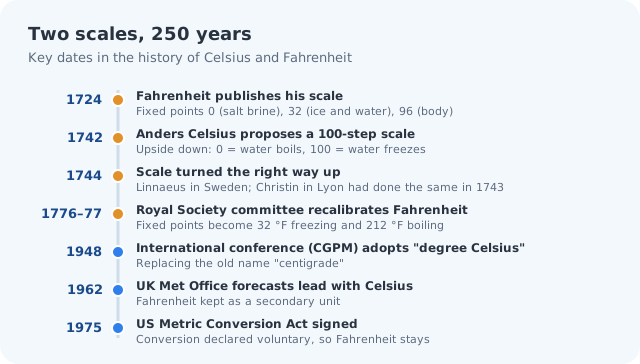
Daniel Gabriel Fahrenheit was born in Danzig (now Gdańsk, Poland) in 1686 and spent most of his working life in the Dutch Republic, where he made and sold scientific instruments. In 1724 he was elected a Fellow of the Royal Society in London and published his thermometer work in its Philosophical Transactions. His scale rested on three fixed points:
- 0°F: a freezing mixture of ice, water and a salt (sal ammoniac), the coldest thing he could reliably make in the workshop.
- 32°F: ice and plain water.
- 96°F: roughly the temperature of a healthy human body.
Boiling water at 212°F was not one of his reference points. It came later: in 1776–77 a Royal Society committee led by Henry Cavendish recalibrated the scale on the freezing and boiling points of water, at 32°F and 212°F. That recalibration is why normal body temperature ended up at about 98.6°F rather than 96°F.
Anders Celsius, a Swedish astronomer, proposed his scale in 1742 with 100 steps between the freezing and boiling points of water. The surprise is that he put them the other way round: 0 was boiling and 100 was freezing. The scale was flipped into its modern form within a few years. Carl Linnaeus used the reversed version in Sweden in 1744, the year Celsius died, and in Lyon Jean-Pierre Christin had published a thermometer with 0 for freezing and 100 for boiling in 1743.

For two centuries the scale was usually called "centigrade". In 1948 the General Conference on Weights and Measures (CGPM) adopted the name "degree Celsius", partly because "centigrade" was also a French unit of angle. Today the degree Celsius is defined from the kelvin: 0°C is exactly 273.15 K.
Which countries still use Fahrenheit?
Fahrenheit was mainly a British and Dutch scale. France and parts of continental Europe used the Réaumur scale until Celsius took over. Most English-speaking countries switched in the 1960s and 1970s as they went metric. The UK Met Office began giving Celsius first in public forecasts in October 1962, with Fahrenheit kept alongside for years. Some British newspapers still quote hot days in Fahrenheit.
Sources do not agree on a single list, so here is what they have in common:
| Status | Countries and territories |
|---|---|
| Fahrenheit is the main everyday scale | United States and its territories (such as Puerto Rico and Guam), Cayman Islands, Palau, Federated States of Micronesia, Marshall Islands |
| Main scale in some sources, shared with Celsius in others | The Bahamas |
| Both scales in common use | Belize, Bermuda, British Virgin Islands and several other Caribbean territories |
| Disputed | Liberia: often listed as a Fahrenheit country, but some recent lists leave it out |
The common thread is close ties to the United States. The Bahamas and the Cayman Islands receive much of their weather information in US style, and Palau, Micronesia and the Marshall Islands are freely associated with the US. Everywhere else, forecasts are given in Celsius.
Why the US never switched
President Gerald Ford signed the Metric Conversion Act on 23 December 1975. It made metric conversion national policy, but Ford stressed that it was to be "completely voluntary". Without deadlines, most everyday uses never moved: thermostats, ovens, road signs and TV weather stayed as they were. Science, medicine and the military use metric and Celsius widely, which is why you will see both on US weather service pages.
The exact formulas
Both scales are linear, so conversion is exact and simple:
- Celsius to Fahrenheit:
°F = °C × 9/5 + 32(9/5 is 1.8) - Fahrenheit to Celsius:
°C = (°F − 32) × 5/9
The 32 shifts the zero point, and the 9/5 accounts for the size of the degree. Water freezes at 0°C and 32°F and boils at 100°C and 212°F, so 100 Celsius degrees span the same range as 180 Fahrenheit degrees.

A "10-degree drop" is not the same on both scales
Because a Fahrenheit degree is smaller (1°F is 5/9 of a Celsius degree), the same number means a different change:
- A drop of 10°F is a drop of about 5.6°C.
- A drop of 10°C is a drop of 18°F.
So when an American forecast says "10 degrees colder tomorrow", expect a fall of under 6°C. The finer steps are one reason some people prefer Fahrenheit for daily weather: whole numbers cover the typical range of −20°C to 45°C in 117 steps (−4°F to 113°F) rather than 65.
Weather temperatures on both scales
The table below converts common weather temperatures exactly, then shows what the popular "double it and add 30" shortcut gives and how far off it is.
| °C | Exact °F | Double + 30 | Error (°F) | What it feels like |
|---|---|---|---|---|
| −30 | −22 | −30 | −8 | Severe winter cold |
| −20 | −4 | −10 | −6 | Hard frost, exposed skin at risk in wind |
| −10 | 14 | 10 | −4 | Cold winter day |
| 0 | 32 | 30 | −2 | Water freezes; ice on roads |
| 10 | 50 | 50 | 0 | Cool; jacket weather |
| 20 | 68 | 70 | +2 | Mild, comfortable |
| 25 | 77 | 80 | +3 | Warm summer day |
| 30 | 86 | 90 | +4 | Hot |
| 35 | 95 | 100 | +5 | Very hot; heat warnings in many places |
| 40 | 104 | 110 | +6 | Extreme heat |
| 45 | 113 | 120 | +7 | Gulf and desert summer peak |
Mental shortcuts and where they break
"Double it and add 30" works because 2 is close to 1.8 and 30 is close to 32. The two errors cancel at exactly one point, 10°C, and grow by 1°F for every 5°C you move away from it. Below 10°C the shortcut reads too cold; above it, too hot.
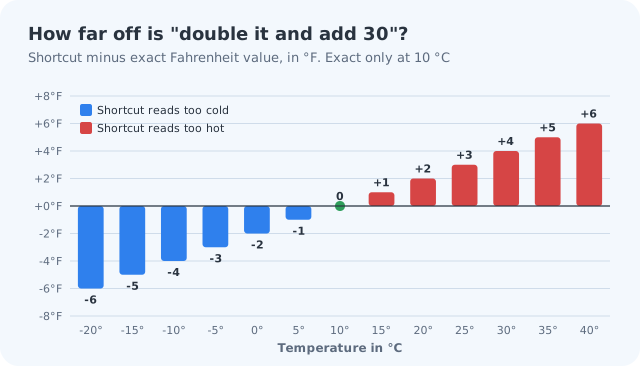
That matters most in heat, which is where the numbers carry warnings. At 40°C the shortcut gives 110°F instead of 104°F. It also should not be used for body temperature: a fever threshold of 38°C is 100.4°F, but the shortcut says 106°F.
Worked example: an exact conversion in your head
There is a mental method that is exact: double, take away a tenth, add 32. It is the same as multiplying by 1.8. Say a forecast gives a high of 29°C:
- Double it: 29 × 2 = 58.
- Take away a tenth of that: 58 − 5.8 = 52.2.
- Add 32: 52.2 + 32 = 84.2°F.
The quick shortcut would have said 88°F, 3.8°F too warm. For a desert high of 42°C the exact method gives 107.6°F, while the shortcut gives 114°F, 6.4°F too warm.
Going the other way, "subtract 30 and halve" is the reverse shortcut. A US forecast of 95°F becomes 32.5°C by the shortcut, but is exactly 35°C. Again, the error grows in the heat.
Reading weather in the other scale
Some practical points for travellers and anyone following foreign forecasts:
- "Feels like" numbers convert the same way. A US heat index of 103°F, where the National Weather Service's "Danger" category begins, is 39.4°C. Our guide to the heat index explains what that number means, and how to read a weather forecast covers feels-like values in general.
- Freezing is the key line. 32°F and 0°C both mean possible ice. A US forecast low of 28°F is −2.2°C: frost on the windscreen.
- Know your comfort band. 18–24°C is 64–75°F. Anything in the 80s°F is warm; the 90s°F is hot (32–37°C).
- Do not mix units within one comparison. If you compare two cities, put them on the same scale first.
On hoyoopin you don't need to convert at all: the °C/°F switch changes every temperature on the site at once, including the live weather, the three-day forecast and the climate tables in each city guide. Rainfall follows the same switch, in millimetres with °C and inches with °F, and your choice is remembered in your browser. When packing for a trip that crosses both systems, our packing guide has temperature-based clothing lists.
The short version
- Exact:
°F = °C × 1.8 + 32and°C = (°F − 32) ÷ 1.8. - Fahrenheit's original fixed points (1724) were 0, 32 and 96; 212°F for boiling came from the 1776–77 recalibration.
- Celsius's 1742 scale was upside down and was flipped within a few years; "degree Celsius" became the official name in 1948.
- Fahrenheit is the main scale in the US and its territories, the Cayman Islands, Palau, Micronesia and the Marshall Islands, with the Bahamas and a few Caribbean territories using both.
- A 10°F change is 5.6°C; a 10°C change is 18°F.
- "Double and add 30" is exact only at 10°C and is 6°F too high at 40°C. Never use it for fever or heat warnings.
Frequently asked questions
How do I convert Celsius to Fahrenheit exactly?
Multiply by 1.8 (or 9/5) and add 32. To go back, subtract 32 and divide by 1.8. For example, 25°C is 25 × 1.8 + 32 = 77°F.
Which countries use Fahrenheit?
Fahrenheit is the main everyday scale in the United States and its territories, the Cayman Islands, Palau, the Federated States of Micronesia and the Marshall Islands. The Bahamas, Belize, Bermuda and some other Caribbean territories use both scales. Liberia is often listed, but sources disagree.
Is a 10-degree change the same in Celsius and Fahrenheit?
No. A 10°F change is about 5.6°C, while a 10°C change is 18°F, because one Fahrenheit degree is 5/9 of a Celsius degree.
How accurate is 'double it and add 30'?
It is exact only at 10°C. It reads 1°F too high for every 5°C above that, so it gives 110°F for 40°C instead of 104°F, and too low below 10°C. Do not use it for fever or heat-warning thresholds.
Sources
- The Fahrenheit Few — EarthDate (University of Texas at Austin)
- Fahrenheit (reference points, 1776–77 recalibration, countries) — Wikipedia
- Celsius (1742 inverted scale, reversal, 1948 CGPM name) — Wikipedia
- Daniel Gabriel Fahrenheit — Wikipedia
- Statement on Signing the Metric Conversion Act of 1975 — The American Presidency Project, UC Santa Barbara
- Who else besides the US uses Fahrenheit these days? — Willamette Week