
How to Prepare for Extreme Heat: Heat Stroke Signs, First Aid and a Heatwave Plan
Heat kills quietly. There is no roof torn off and no flooded street, so heatwaves are easy to underestimate. The World Health Organization calls heat stress the leading cause of weather-related deaths and estimates about 489,000 heat-related deaths a year worldwide between 2000 and 2019. This guide covers how to tell heat exhaustion from heat stroke, what to do for each, and how to get yourself, your home and the people around you ready before the next hot spell.
How big the risk is
In the United States, the National Weather Service (NWS) counts weather deaths by hazard every year. In 2024 heat killed 529 people, nearly half of the 1,084 weather deaths recorded. Floods (flash and river) killed 149, hurricanes and tropical storms 78 and tornadoes 52. Heat alone killed about 1.9 times as many people as those three hazards combined.
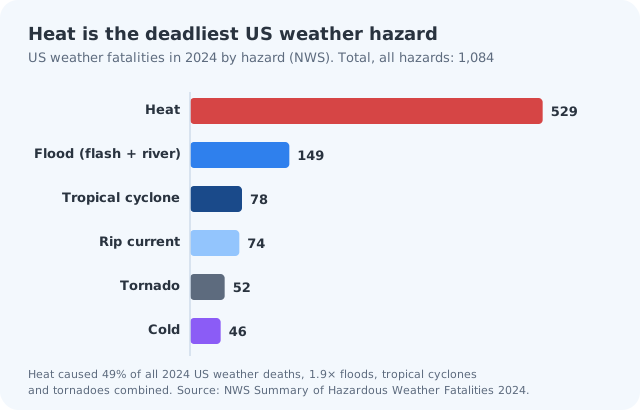
The trend is not in the right direction either. The IPCC's 2021 assessment found that hot extremes, including heatwaves, have become more frequent and more intense across most land regions since the 1950s.
Heat exhaustion or heat stroke?
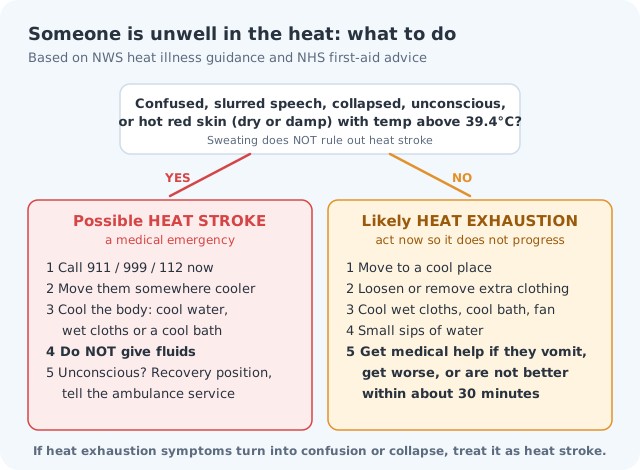
These are two different conditions, and the first aid is different. Heat exhaustion is the body struggling to keep up. Heat stroke is the body's cooling system failing, and it is a medical emergency in which delay can be fatal. The table below follows the NWS heat illness guide, with the NHS 30-minute rule added.
| Heat exhaustion | Heat stroke | |
|---|---|---|
| Typical signs | Heavy sweating; cool, pale, clammy skin; fast, weak pulse; nausea or vomiting; muscle cramps; tiredness or weakness; dizziness; headache; fainting | Body temperature above 39.4°C (103°F); hot, red skin that may be dry or damp; fast, strong pulse; throbbing headache; confusion or slurred speech; dizziness, nausea; fainting or loss of consciousness |
| First call | Not usually an emergency if the person recovers with cooling | Call emergency services immediately |
| Cooling | Move to a cool, preferably air-conditioned place; loosen or remove extra clothing; cool wet cloths or a cool bath | Move to a cooler place while waiting for help; cool the body with cool water, wet cloths or a cool bath |
| Fluids | Small sips of water (stop if they feel sick) | Do not give fluids, especially if the person is confused, drowsy or unconscious |
| Escalate when | They vomit, symptoms get worse, or they are not improving within about 30 minutes (NHS) or symptoms last more than an hour (NWS) | Already an emergency. If they lose consciousness, check their breathing: if they are breathing, put them in the recovery position; if not, start CPR and follow the call handler's instructions |
Two mistakes to avoid
- Waiting for dry skin. Older guides describe heat stroke as "hot, dry skin". The NWS now says hot, red, dry or damp. A runner or labourer with heat stroke may still be sweating. Confusion is the warning sign that matters most.
- Giving a drink to someone who is confused or unconscious. They may not be able to swallow safely. The NWS is blunt: for heat stroke, do not give fluids.
Fans have limits too. The NWS says a fan helps only when the heat index is below the high 90s °F (about 35–37°C); above that, moving hot air over the skin can make you hotter. Wet the skin first if a fan is all you have, and get the person somewhere cooler.
Know the numbers in your forecast
Air temperature alone understates heat stress when the air is humid. The NWS heat index combines temperature and humidity, and its current chart puts the risk bands here:
| NWS category | Heat index | With prolonged exposure or activity |
|---|---|---|
| Caution | 80–90°F (27–32°C) | Fatigue; continued activity could cause heat cramps |
| Extreme caution | 90–103°F (32–39°C) | Heat cramps and heat exhaustion possible |
| Danger | 103–124°F (39–51°C) | Heat cramps or heat exhaustion likely; heat stroke possible |
| Extreme danger | 125°F and above (52°C+) | Heat stroke highly likely |
Say your forecast shows 35°C with 50% humidity. The NWS formula puts the heat index at about 40.7°C (105°F), inside the Danger band. Our heat index explainer walks through the formula step by step, and how to read a weather forecast explains the "feels like" figure most apps show. Remember that the index assumes shade: the NWS says full sun can add up to 15°F (about 8°C).
Before a heatwave
Most of the useful work happens before the heat arrives.
- Sign up for official warnings. Use your national system: NWS heat advisories and HeatRisk in the US, the UKHSA and Met Office Heat-Health Alerts (yellow, amber, red) in England, and the India Meteorological Department's heatwave warnings in India.
- Find your cool place. If home has no air conditioning, note where you could spend the hottest hours: a library, a cooling centre, a relative's flat.
- Prepare the home. Curtains or blinds on sun-facing windows, a working fan for evenings, a thermometer indoors, ice packs in the freezer.
- Check medicines. CDC guidance for clinicians lists many drug types that raise heat risk, including diuretics, blood-pressure medicines (beta blockers, ACE inhibitors and others), antidepressants, antipsychotics, lithium, anticholinergics and stimulants. Do not stop a medicine on your own; ask your doctor or pharmacist how to manage it in hot weather.
- Make a check-in list. Older people, babies and young children, pregnant people, people with heart, lung or kidney disease, outdoor workers and anyone who lives alone are at higher risk.
During a heatwave
- Time your day. UV is strongest from about 10am to 4pm (NOAA; the NHS uses 11am to 3pm for the UK), but air temperature usually peaks later, in the mid-to-late afternoon. Do errands and exercise early in the morning.
- Dress for it. Loose, light-coloured clothing and a wide-brimmed hat.
- Keep checking on people. Call or visit at-risk neighbours and relatives at least once a day, and more often in the hottest spells.
- Go easy on alcohol and very sugary drinks. Water is the default. Moderate amounts of tea and coffee are fine for most people.
How much to drink, and how much is too much
For people working in the heat, NIOSH (part of the US CDC) advises about 1 cup (8 oz) of water every 15–20 minutes, and no more than 48 oz an hour. In metric:
- 1 cup every 20 minutes = 3 cups = about 710 ml an hour
- 1 cup every 15 minutes = 4 cups = about 950 ml an hour
- Upper limit: 48 oz = about 1.4 litres an hour
The ceiling matters. Drinking far more than you sweat can dilute the salt in your blood (hyponatraemia), which is also a medical emergency. If your doctor has told you to limit fluids, for example because of heart or kidney disease, ask them what to do in a heatwave rather than following general advice.
Never leave anyone in a parked car
A closed car is a greenhouse. A Stanford study published in Pediatrics in 2005 measured cars parked in the sun on days between 22°C and 36°C (72–96°F). The interior rose by an average of about 22°C (40°F) within an hour, whatever the outside temperature, and 80% of that rise came in the first 30 minutes. A cracked window made no meaningful difference.
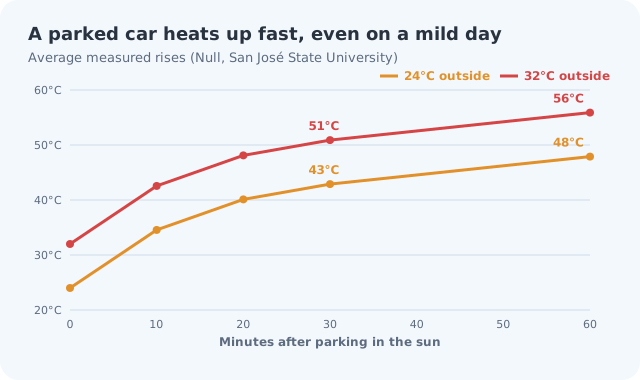
On a pleasant 24°C day, those average rises put the cabin at about 43°C after 30 minutes and 48°C after an hour. Children heat up much faster than adults. According to Null's tracking at noheatstroke.org, more than 1,000 children have died of vehicular heatstroke in the US since 1998 (1,014 as of 2026), an average of about 37 a year. Leave a bag or phone on the back seat as a reminder, lock the car when parked so children cannot climb in, and if you see a child alone in a hot car, call the emergency number.
Using hoyoopin during hot spells
hoyoopin's Weather page shows the current temperature, humidity, wind and a "feels like" value for any city, plus today's chance of rain and a three-day forecast of highs and lows, which helps you spot the hottest afternoon coming. The live data comes from WeatherAPI.com; we don't calculate the feels-like value ourselves, and WeatherAPI does not publish its formula. hoyoopin does not issue heat warnings or alerts, so always follow your national weather service for those. For trip planning, our city guides show the usual monthly highs and lows from 1991–2020 climate normals, and the packing guide covers what to bring for hot destinations.
Quick checklist
- Confused, collapsed or very hot? Call emergency services, cool the person, give no fluids.
- Sweaty, pale, dizzy? Move to a cool place, loosen clothes, sips of water, and call emergency services if they are not better within 30 minutes, or sooner if they become confused or vomit.
- Know your heat index: NWS Danger starts at 39.4°C (103°F), and full sun can add 8°C.
- Drink regularly before you feel thirsty. Resting indoors, aim for pale urine rather than a fixed amount; if working hard in heat, roughly 0.7–1 litre an hour, never more than about 1.4 litres an hour, with electrolyte drinks for work lasting over 2 hours.
- Check on at-risk people daily and ask about their medicines.
- Never leave a child or pet in a parked car, even for a few minutes.
Frequently asked questions
How can I tell heat exhaustion from heat stroke?
Heat exhaustion usually brings heavy sweating, cool and clammy skin, dizziness, nausea and a fast, weak pulse. Heat stroke is an emergency: body temperature above about 39.4°C (103°F), hot red skin that may be dry or damp, and confusion, slurred speech or collapse. If in doubt, call emergency services.
Should I give water to someone with heat stroke?
No. The US National Weather Service says not to give fluids to someone with heat stroke. They may be confused or drowsy and unable to swallow safely. Call emergency services and cool them with cool water, wet cloths or a cool bath while you wait.
How much water should I drink in a heatwave?
If you are resting indoors, drink regularly through the day, before you feel thirsty, and aim for pale urine; you do not need a litre an hour. For people working or exercising in the heat, NIOSH advises about one cup (237 ml) every 15 to 20 minutes, roughly 0.7 to 1 litre an hour, no more than about 1.4 litres an hour, and drinks with electrolytes for work in heat lasting more than 2 hours. Drinking too much plain water can dangerously lower blood salt. People on fluid restriction should ask their doctor.
How hot does a parked car get?
In a Stanford study published in Pediatrics in 2005, cars parked in the sun warmed by an average of about 22°C (40°F) within an hour, with 80% of the rise in the first 30 minutes, on days from 22°C to 36°C. Cracking a window made little difference.
Sources
- Heat illness: heat cramps, heat exhaustion, heat stroke — National Weather Service
- Heat exhaustion and heatstroke — NHS 111 Wales
- Summary of Hazardous Weather Fatalities, 2024 — National Weather Service
- UN Secretary-General calls for global action on extreme heat — World Health Organization
- Heat Stress: Hydration — CDC / NIOSH
- Parked cars get dangerously hot, even on cool days — Stanford Medicine