
Social Jetlag: How Your Schedule and Time Zone Affect Your Sleep
If you sleep from midnight to 6:30 on workdays and from 2:00 to 10:00 at the weekend, your body spends every Monday adjusting as if you had flown a few time zones east. Researchers call this social jetlag: the gap between the sleep timing your body clock prefers and the timing your work or school schedule imposes. You can measure it from a simple sleep log, and where you live inside your time zone can make it bigger.
Where the term comes from
The term was introduced in 2006 by Marc Wittmann, Jenny Dinich, Martha Merrow and Till Roenneberg in the paper "Social jetlag: misalignment of biological and social time", published in Chronobiology International. Surveying 501 volunteers, they found that late chronotypes, the people whose body clocks run later, showed the biggest differences in sleep timing between workdays and free days. The links they found between chronotype and wellbeing or stimulant use, smoking in particular, were strongest in teenagers and young adults up to about 25 (late types smoked more at most ages), and the authors argued these were most probably a consequence of social jetlag rather than of being a late type as such.
Unlike travel jet lag, social jetlag never ends with a few days of adjustment. It repeats every week, because the schedule pulls one way on workdays and the body clock pulls back on free days.
How to measure it
The standard measure compares the midpoint of sleep, the halfway point between falling asleep and waking up, on workdays and on free days:
SJL = | MSF − MSW |
Here MSF is the midpoint of sleep on free days and MSW the midpoint on workdays.
A midpoint is used instead of bedtime or wake time because it reflects when you sleep regardless of how long you sleep.
Worked example
Take the sleep log from the introduction:
- Workdays: asleep 00:00, alarm 06:30. That is 6 hours 30 minutes of sleep, and the midpoint is 03:15.
- Free days: asleep 02:00, awake 10:00 without an alarm. That is 8 hours of sleep, and the midpoint is 06:00.
- Social jetlag: 06:00 − 03:15 = 2 hours 45 minutes.
That is close to flying from New York to Los Angeles every Friday and back every Sunday, a three-hour shift each way. The log also shows a second problem: 1 hour 30 minutes less sleep per workday, which the person is trying to repay at the weekend.
| Sleeper | Workdays (midpoint) | Free days (midpoint) | Gap |
|---|---|---|---|
| Early type | 22:30–06:30 (02:30) | 23:00–07:30 (03:15) | 45 min |
| Intermediate | 23:30–07:00 (03:15) | 00:30–08:30 (04:30) | 1 h 15 min |
| Late type | 00:00–06:30 (03:15) | 02:00–10:00 (06:00) | 2 h 45 min |
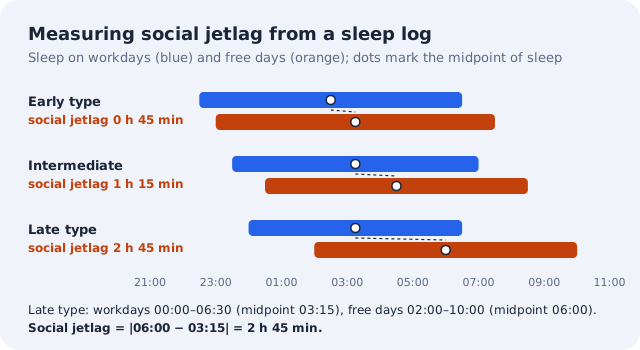
To work out your own number, log sleep and wake times for two normal weeks, average the workday and free-day midpoints separately, and take the difference. A free day here means a day without an alarm or a fixed morning commitment.
How common it is
In the large questionnaire dataset analysed by Roenneberg and colleagues in 2012, about 70% of people had more than one hour of social jetlag. Late chronotypes tend to have the most, since typical work and school start times are closer to the preferences of earlier body clocks, and the 2006 study found the strongest effects in people up to about 25.
What it has been linked to
Most evidence comes from observational studies, which show associations. People with more social jetlag also differ in other ways, such as age and type of job, so these findings do not show that social jetlag itself causes the outcomes.
- Body weight. Roenneberg and colleagues reported in Current Biology (2012) that social jetlag was associated with higher body mass index, beyond the effect of sleep duration.
- Smoking and stimulants. The 2006 study found the strongest correlation between late chronotype, social jetlag and smoking.
- Metabolic and heart health, and mood. The American Academy of Sleep Medicine's 2020 position statement notes associations with obesity, metabolic syndrome, cardiovascular disease and depression. Results for mood are less consistent across studies.
Where time zones come in
Your body clock is set mainly by daylight, especially morning light. Official clocks are set by time zones, which are political and can be very wide. The same clock time therefore means a different sun position depending on where you are in the zone.
Central European Time is a good illustration. Warsaw, Berlin, Paris, Madrid and A Coruña in northwest Spain all use the same clock, although A Coruña is about 29 degrees of longitude west of Warsaw. Most of Spain lies west of the Greenwich meridian but uses UTC+1: in Madrid the sun sets at 21:48 on the clock in late June.

On 21 June 2027 the sun sets at 21:01 in Warsaw and at 22:17 in A Coruña, and solar noon in A Coruña falls at 14:35 on the clock. People on the western edge of a zone get more evening light, which tends to push body clocks later, but still start work by the same clock as people farther east.
Economists Osea Giuntella and Fabrizio Mazzonna used this effect as a natural experiment on either side of US time zone borders. In their 2019 paper in the Journal of Health Economics, an extra hour of evening natural light reduced sleep by about 19 minutes on average and was associated with higher rates of obesity, diabetes and cardiovascular disease, and with lower per capita income. Because people on both sides of a border are otherwise similar, this design gets closer to cause and effect than a simple survey, though it is still not a clinical trial.
Daylight saving time adds a shift twice a year
Daylight saving time moves the clock, not the sun. The spring change is the one with documented short-term harm: clocks jump forward, mornings get darker, and people lose sleep. The American Academy of Sleep Medicine cites an increase of up to 6% in fatal car crashes in the US in the days after the spring change, and it recommends year-round standard time. The same statement notes that the social jetlag linked to daylight saving time may be worse in the westernmost parts of a time zone. The autumn change moves the clock back toward sun time and has far less documented harm.
For the dates of the next clock changes in major cities, see our guide to scheduling meetings across time zones.
What you can do
You can't move your time zone, but you can reduce the gap between your workday and free-day sleep:
- Measure first. Two weeks of sleep logs tell you whether your social jetlag is 30 minutes or three hours.
- Get daylight early in the day. Morning light helps move a late body clock earlier.
- Dim bright light late in the evening, since evening light pushes the clock later.
- Narrow the weekend shift gradually. Getting up within an hour or so of your workday time is easier to sustain than a sudden change.
- Use schedule flexibility where you have it. For remote teams, a policy that avoids recurring 7:00 meetings for late types helps. Our guide to managing remote teams across time zones covers meeting rotation.
The short version
- Social jetlag is the difference between your sleep midpoint on free days and on workdays.
- About 70% of people in one large dataset had more than an hour of it, and late types have the most.
- It is associated with higher BMI, smoking and metabolic risk, but causation is not established.
- Living on the western edge of a time zone means later sunsets, which is linked to shorter sleep.
- The spring clock change adds a short-term sleep loss that the autumn change does not.
Frequently Asked Questions
How do you calculate social jetlag?
Find the midpoint of your sleep on workdays and on free days, then take the difference. Sleeping 00:00 to 06:30 on workdays (midpoint 03:15) and 02:00 to 10:00 on free days (midpoint 06:00) gives a social jetlag of 2 hours 45 minutes.
Who coined the term social jetlag?
Marc Wittmann, Jenny Dinich, Martha Merrow and Till Roenneberg introduced it in a 2006 paper in Chronobiology International, describing the misalignment between biological and social time.
Does sleeping in on weekends cure social jetlag?
No. Sleeping in can repay some lost sleep, but it shifts your free-day sleep midpoint later, which increases social jetlag as it is measured.
Does daylight saving time make social jetlag worse?
The spring change, when clocks go forward, is linked to short-term sleep loss and more fatal car crashes in the following days. The American Academy of Sleep Medicine recommends permanent standard time.
Sources
- Social jetlag: misalignment of biological and social time (Wittmann et al., 2006) — Chronobiology International, via PubMed
- Social jetlag and obesity (Roenneberg et al., 2012), summary — ScienceDaily
- Sunset time and the economic effects of social jetlag: evidence from US time zone borders (Giuntella and Mazzonna, 2019) — Journal of Health Economics, via Università della Svizzera italiana
- Daylight saving time: an American Academy of Sleep Medicine position statement (2020) — Journal of Clinical Sleep Medicine, via PMC
- Social jetlag — Wikipedia