
UN M49 Regions Explained: The Codes Behind UN Statistics
What M49 is
M49 is the United Nations Statistics Division's list of Standard Country or Area Codes for Statistical Use. It was first published in 1970 as "Series M, No. 49", which is where the name comes from. It does two jobs:
- It gives every country or area a 3-digit numeric code, such as
404for Kenya or840for the United States. - It groups those countries or areas into geographic regions, each with its own 3-digit code, so that UN agencies can publish comparable totals for "Western Africa" or "South America".
The list covers 248 countries or areas, not just the 193 UN member states. Territories such as Greenland, Réunion and Puerto Rico have their own entries, because statistics are collected for them separately.
UNSD is explicit that the grouping is a statistical tool, not a political statement. Its M49 page says the assignment of countries or areas to groupings "is for statistical convenience and does not imply any assumption regarding political or other affiliation of countries or territories".
The hierarchy: regions, sub-regions, intermediate regions
M49 has four geographic levels below the World (001):
- 5 regions: Africa
002, Americas019, Asia142, Europe150and Oceania009. - 17 sub-regions: two in Africa, two in the Americas, five in Asia, four in Europe and four in Oceania.
- 8 intermediate regions, used only where a sub-region is very large: the four parts of Sub-Saharan Africa, the three parts of Latin America and the Caribbean, and the Channel Islands within Northern Europe.
- Countries or areas, each with its own code.
Antarctica (010) sits directly under the World and belongs to no region.
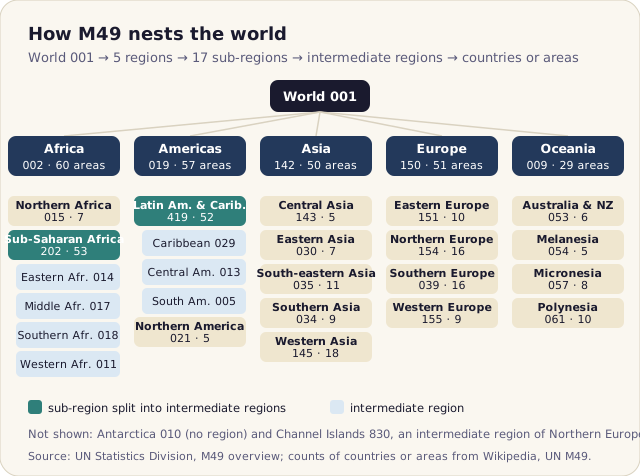
| Region | Sub-region (code) | Intermediate regions (code) | Countries or areas |
|---|---|---|---|
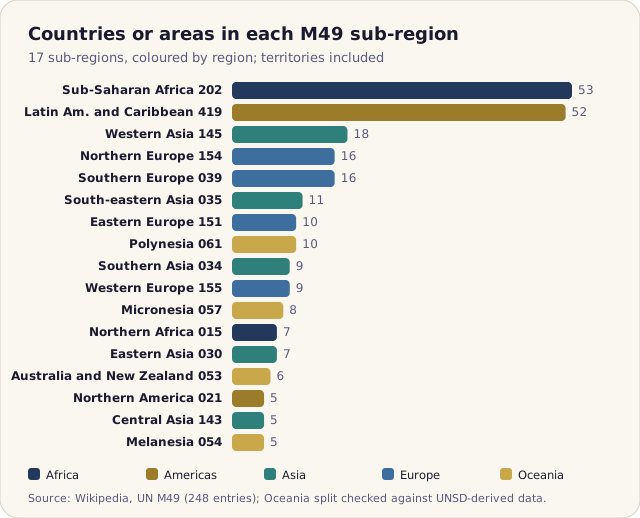
| Africa 002 | Northern Africa 015 | none | 7 |
| Africa 002 | Sub-Saharan Africa 202 | Eastern 014, Middle 017, Southern 018, Western 011 | 53 |
| Americas 019 | Latin America and the Caribbean 419 | Caribbean 029, Central America 013, South America 005 | 52 |
| Americas 019 | Northern America 021 | none | 5 |
| Asia 142 | Central 143, Eastern 030, South-eastern 035, Southern 034, Western 145 | none | 50 |
| Europe 150 | Eastern 151, Northern 154, Southern 039, Western 155 | Channel Islands 830 (in Northern Europe) | 51 |
| Oceania 009 | Australia and New Zealand 053, Melanesia 054, Micronesia 057, Polynesia 061 | none | 29 |
Two codes are easy to mix up. Western Europe is 155 (France, Germany, the Benelux countries, Austria, Switzerland, Liechtenstein and Monaco), and Southern Europe is 039 (Italy, Spain, Portugal, Greece, the western Balkans, Malta and the microstates). The code 152 is not a region at all: it is Chile's country code.
Edge cases that surprise people
Because M49 is drawn for statistics, a few placements differ from what school atlases or politics might suggest.
| Country or area | M49 placement | Why it surprises |
|---|---|---|
Russia 643 | Eastern Europe 151 | The whole country, including Siberia, counts as Europe |
Turkey 792, Cyprus 196 | Western Asia 145 | Cyprus is an EU member; Turkey spans both continents |
| Georgia, Armenia, Azerbaijan | Western Asia 145 | All three are Council of Europe members |
Mexico 484 | Central America 013 | Not in Northern America, which holds only Bermuda, Canada, Greenland, Saint Pierre and Miquelon, and the US |
Greenland 304 | Northern America 021 | Part of the Kingdom of Denmark, which is in Northern Europe |
Antarctica 010 | No region | The only entry outside all five regions |
Two places that have their own hoyoopin pages, Kosovo and Taiwan, do not appear in the M49 list at all. The State of Palestine does appear in M49 (Western Asia) but is not one of hoyoopin's 196 countries.
Codes shared with ISO 3166
The M49 country codes are older than ISO's numeric codes. UNSD released them from 1970, and the second edition of ISO 3166-1 adopted them in 1981 as its numeric codes. That is why Kenya is 404 in both systems, and why the numeric code is the safest key for matching a country to UN data. The ISO country codes guide explains the letter codes that go with it.
The region codes are M49-only. ISO 3166 has no regions, so a code like 155 will never appear as a country. One practical tip for anyone handling either set: M49 codes always have three digits, with leading zeros, as in 039 for Southern Europe or 004 for Afghanistan. Store them as text rather than numbers, or a spreadsheet will quietly turn 039 into 39 and break every lookup.
Other M49 groupings
Next to the geographic tree, M49 keeps three lists used in development statistics: Least Developed Countries (199), Landlocked Developing Countries (432) and Small Island Developing States (722). The old split into "developed" and "developing" regions, introduced in 1996, was removed in December 2021.
How hoyoopin's six continents compare
hoyoopin does not use M49 regions, and its country pages do not show an M49 region or sub-region. It sorts its 196 countries into six continents: Africa, Asia, Europe, North America, South America and Oceania. M49 has five regions, because it treats the Americas as one region.
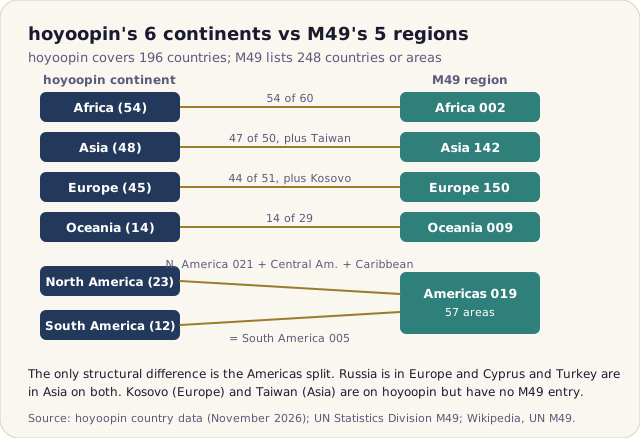
| hoyoopin continent | Countries on hoyoopin | M49 equivalent | M49 countries or areas |
|---|---|---|---|
| Africa | 54 | Africa 002 | 60 |
| Asia | 48 | Asia 142 (plus Taiwan) | 50 |
| Europe | 45 | Europe 150 (plus Kosovo) | 51 |
| North America | 23 | Northern America 021 + Central America 013 + Caribbean 029 | 41 |
| South America | 12 | South America 005 | 16 |
| Oceania | 14 | Oceania 009 | 29 |
Apart from splitting the Americas, hoyoopin's continents follow the same lines as M49: Russia is listed under Europe, while Turkey, Cyprus and the three South Caucasus countries are under Asia. Mexico, Central America and the 13 Caribbean nations are in North America. The gaps in the counts are territories, which M49 lists and hoyoopin does not; the guide to territories and dependencies covers them.
Key takeaways
- M49 is the UN Statistics Division's code list: 248 countries or areas, 5 regions, 17 sub-regions and 8 intermediate regions.
- Western Europe is
155and Southern Europe is039. - The groupings are for statistical convenience and carry no political meaning.
- M49 country codes are the same as ISO 3166-1 numeric codes.
- hoyoopin uses six continents and no M49 regions; the only structural difference is that it splits the Americas into North and South America.
Frequently asked questions
How many regions and sub-regions does the UN M49 standard have?
Five regions (Africa, Americas, Asia, Europe, Oceania) and 17 sub-regions. Eight intermediate regions add detail inside Sub-Saharan Africa, Latin America and the Caribbean, and Northern Europe (the Channel Islands). Antarctica sits outside every region.
What are the M49 codes for Western and Southern Europe?
Western Europe is 155 and Southern Europe is 039. Eastern Europe is 151 and Northern Europe is 154. The code 152 is not a region; it is Chile's country code.
Are M49 country codes the same as ISO 3166 numeric codes?
Yes. The UN Statistics Division published the 3-digit country codes from 1970, and ISO 3166-1 adopted them as its numeric codes in its 1981 second edition. Kenya, for example, is 404 in both.
Does hoyoopin use the UN M49 regions?
No. hoyoopin groups its 196 countries into six continents and does not show M49 regions. Its continents follow the M49 regions except that the Americas are split into North America (including Central America and the Caribbean) and South America.
Sources
- Standard country or area codes for statistical use (M49), United Nations Statistics Division
- UN M49, Wikipedia
- World Bank Country and Lending Groups, World Bank Data Help Desk
- Micronesia, Wikipedia
- World Population Prospects 2024, UN DESA Population Division