
GMT, UTC and the world's time zones explained
A webinar invite says 15:00 GMT, and a server log says 15:00 UTC. For booking a call, these are the same moment. But GMT and UTC are not the same kind of thing. GMT is a time zone with a 19th-century astronomical history. UTC is the atomic time standard that every time zone, GMT included, is now defined against, and every clock on Earth is set as an offset from it.
This guide explains where each one came from, how far apart they can drift (less than a second), the one situation where mixing them up costs people a full hour, and how the world's offsets from UTC are laid out.

What GMT is
Greenwich Mean Time is the mean solar time at the Royal Observatory in Greenwich, London, founded in 1675 to help sailors find their longitude at sea. "Mean" matters here. The real Sun is an irregular clock: because Earth's orbit is elliptical and its axis is tilted, sundial noon drifts up to about 16 minutes ahead of, or 14 minutes behind, an evenly running clock over the year. GMT smooths that out by tracking an imaginary "mean Sun" that crosses the Greenwich meridian at exactly 12:00 every day.

GMT spread through Britain on the railways. Train companies adopted "railway time" set to Greenwich from 1847, because each town had previously kept its own local time; Bristol, for example, ran about ten minutes behind London. The Statutes (Definition of Time) Act 1880 then made GMT the legal time across Great Britain.
In 1884 the International Meridian Conference in Washington, D.C. chose the Greenwich meridian as the world's prime meridian, longitude 0°. Twenty-two nations voted in favour, San Domingo voted against, and France and Brazil abstained. France kept the Paris meridian for its own time until 1911. The conference did not create the 24 time zones; they spread country by country afterwards, each one defined as a whole number of hours (sometimes a half or quarter) from Greenwich.
What UTC is
By the mid-20th century, atomic clocks had shown that Earth itself is an imperfect timekeeper. Tides slow its spin very gradually, and movements in the core, oceans and atmosphere make the length of a day wobble by milliseconds. In 1967 the second was redefined by physics instead of astronomy: exactly 9,192,631,770 oscillations of the caesium-133 atom.
Coordinated Universal Time (UTC) is built on those atomic seconds. The International Bureau of Weights and Measures (BIPM) near Paris combines readings from roughly 450 atomic clocks in more than 80 laboratories into International Atomic Time (TAI). UTC is TAI with whole leap seconds removed so it stays within 0.9 seconds of Earth's actual rotation, measured as UT1, the modern successor to astronomical GMT.
UTC in its current form began on 1 January 1972, when it was set 10 seconds behind TAI and took over from GMT as the reference for civil time. Twenty-seven leap seconds have been added since, the last at 23:59:60 UTC on 31 December 2016, so UTC now trails TAI by 37 seconds. The initials are a deliberate compromise: English speakers proposed CUT, French speakers TUC, and the neutral "UTC" was adopted for all languages.
UTC never changes for the seasons. When people say "Tokyo is UTC+9", they mean Tokyo clocks read nine hours ahead of UTC all year; when a country starts daylight saving, it changes its offset, not UTC.
So are GMT and UTC the same?
For any clock you will ever look at, yes: when the UK is on GMT, its clocks show UTC exactly. The difference is in what each term is.
| Term | What it is | Based on | Offset from UTC |
|---|---|---|---|
| UTC | World time standard | Atomic clocks + leap seconds | 0 |
| GMT | Time zone (UK, Ireland, Iceland, much of West Africa) | Defined today as UTC+0 | 0 |
| UT1 | Earth-rotation time for astronomy and navigation | Observations of distant quasars | Within ±0.9 s |
| TAI | Continuous atomic time scale | Weighted average of ~450 clocks | +37 s |
| GPS time | Satellite navigation time scale | Atomic; fixed to UTC in January 1980 | +18 s |
In standards language, GMT is no longer a precise scientific term at all. Astronomers use UT1, and engineers, pilots and programmers use UTC. "GMT" survives as the everyday name of the UK's winter time zone.
The real trap: London is not always on GMT
The sub-second gap between GMT and UTC never matters in practice. What catches people out is assuming that "GMT" means "London time". From the last Sunday in March to the last Sunday in October, the UK switches to British Summer Time (BST), UTC+1, with both changes at 01:00 UTC. So for seven months of the year, London is one hour ahead of GMT.
London's next switch to summer time is on 28 March 2027. Its next return to GMT is on 31 October 2027. Right now London is on UTC±0; the London guide shows the live time.
A worked example: a colleague in New York schedules a call for "2 PM GMT" on 15 July. Read literally, that is 14:00 UTC, which is 15:00 in London and 10:00 in New York (EDT, UTC−4). If they actually meant "2 PM London time", the call is at 13:00 UTC and 9:00 in New York. When an invite says GMT between April and October, it is worth asking which one they mean, or writing the time as UTC or with a city name.

Where GMT and UTC are used
Computers and the internet
Servers, databases and network protocols keep time in UTC, because it never jumps for daylight saving. Timestamps in the ISO 8601 format mark UTC with a "Z", as in 2026-10-31T14:00:00Z. Your phone or laptop then converts UTC to local time for display using the IANA time zone database, the same database behind hoyoopin's world clock. One quirk for programmers: in that database, the zone named Etc/GMT+5 means UTC−5. The sign is inverted for historical POSIX reasons, so use city zones such as America/New_York instead.
Aviation, shipping and the military
Flight plans, air traffic control and weather reports all use UTC, often called "Zulu" time. The letter Z marks the zero-offset zone, and "Zulu" is Z in the NATO phonetic alphabet, so 1400Z is spoken "fourteen hundred Zulu".
Which countries use GMT?
All year round, with no daylight saving: Iceland, Ghana, Senegal, Côte d'Ivoire, Mali, Burkina Faso, The Gambia, Guinea, Guinea-Bissau, Liberia, Mauritania, Sierra Leone, Togo and São Tomé and Príncipe, plus the British territory of Saint Helena.
In winter only: the United Kingdom, Ireland, Portugal (mainland and Madeira), the Faroe Islands and Spain's Canary Islands, which all move to UTC+1 in summer. Morocco joined the all-year group on 20 September 2026, when it left UTC+1 (and its switches to UTC+0 for Ramadan) for permanent UTC+0.
Leap seconds are ending
Leap seconds are rare and unpredictable, and software has repeatedly failed when one is inserted. In 2022 the General Conference on Weights and Measures (CGPM) resolved to raise the 0.9-second limit by 2035. At its meeting on 15 October 2026 it went further: from 20 May 2027 UTC becomes continuous, and the allowed gap between UTC and Earth-rotation time grows to one hour. UTC, and GMT with it, will slowly drift away from solar time, by seconds over decades. Nobody will notice on a wall clock, and no offset moves: when UTC drifts, every local clock drifts with it.
UTC offsets: how the world's clocks are set
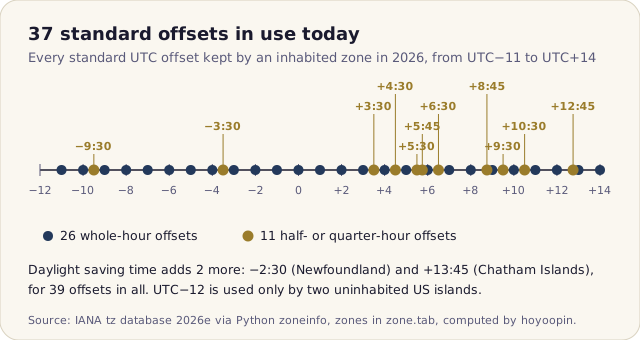
The textbook picture is 24 neat zones, each 15 degrees of longitude wide. Real clocks follow borders and politics instead, and the offsets do not stop at ±12. Using the IANA time zone database (the data behind phones, computers and servers, version 2026e), we counted the standard offset kept by every inhabited zone in 2026:
- 37 distinct standard offsets are in use, from UTC−11 (American Samoa, Niue) to UTC+14 (Kiribati's Line Islands).
- 26 of them are whole hours and 11 are half- or quarter-hour offsets.
- Daylight saving time adds two more that never occur as standard time, UTC−2:30 (Newfoundland in summer) and UTC+13:45 (New Zealand's Chatham Islands in summer), for 39 offsets in all.
- UTC−12 exists, but only for two uninhabited US islands, Baker and Howland.
Half-hour and quarter-hour offsets
Most countries picked a whole-hour offset close to their longitude. A few chose a half or quarter hour, usually to keep clock noon closer to solar noon or to set themselves apart from a neighbour. The best-known case is Nepal, at UTC+5:45 since 1986, exactly 15 minutes ahead of India. Our guide to fractional time zones explains the history behind each one.
| Standard offset | Where it is used |
|---|---|
| UTC−9:30 | Marquesas Islands (French Polynesia) |
| UTC−3:30 | Newfoundland (Canada) |
| UTC+3:30 | Iran |
| UTC+4:30 | Afghanistan |
| UTC+5:30 | India, Sri Lanka |
| UTC+5:45 | Nepal |
| UTC+6:30 | Myanmar, Cocos (Keeling) Islands |
| UTC+8:45 | Eucla area, Western Australia |
| UTC+9:30 | Northern Territory and South Australia |
| UTC+10:30 | Lord Howe Island (Australia) |
| UTC+12:45 | Chatham Islands (New Zealand) |
Countries with the most time zones
Counting overseas territories, France uses more time zones than any other country: 12, from UTC−10 in Tahiti to UTC+12 in Wallis and Futuna, including uninhabited Clipperton Island at UTC−8. Adding its Antarctic claim, Adélie Land, makes 13. Metropolitan France itself has a single zone, UTC+1 (UTC+2 in summer).

In the table, zone counts and standard ranges include each country's territories. The last column shows the standard offsets on the country's hoyoopin page, which covers the zones the IANA database files under that country's own code; territories such as French Polynesia or Puerto Rico have codes of their own.
| Country | Zones | Standard range | Standard offsets on hoyoopin's page |
|---|---|---|---|
| France | 12 | UTC−10 to UTC+12 | UTC+1 (metropolitan France) |
| United States | 11 | UTC−12 to UTC+12 | UTC−10 to UTC−5 (the 50 states) |
| Russia | 11 | UTC+2 to UTC+12 | UTC+2 to UTC+12 |
| United Kingdom | 9 | UTC−8 to UTC+6 | UTC+0 (UK itself) |
| Australia | 9 | UTC+5 to UTC+11 | UTC+8 to UTC+10:30 |
| Canada | 6 | UTC−8 to UTC−3:30 | UTC−8 to UTC−3:30 |
Russia is the record holder within its own borders: 11 zones, all on Russian soil, from the Kaliningrad exclave on the Baltic (UTC+2) to Kamchatka and Chukotka (UTC+12).
Big countries that chose one zone
China has used Beijing time, UTC+8, for the whole country since 1949, even though it spans about 60 degrees of longitude, roughly five geographical time zones. In far-western Xinjiang, many people also use an unofficial local time two hours behind Beijing; the IANA database records it as a separate zone, Asia/Urumqi, which is why hoyoopin's China page lists a UTC+6 group next to Beijing time. India has a single zone, UTC+5:30, across the whole country.
Kazakhstan is the newest example. It had been split between UTC+5 in the west and UTC+6 in the east, and on 1 March 2024 the eastern half, including the capital Astana, moved its clocks back an hour so the whole country now runs on UTC+5.
The date line and the day Samoa skipped
Countries near the International Date Line choose which side of it to be on, and two Pacific nations have switched sides.
Kiribati straddled the line until the end of 1994, so its eastern and western islands were on different calendar days. It then moved the Line Islands from UTC−10 to UTC+14, putting the whole country on the same date. Kiritimati, in the Line Islands, is now among the first inhabited places to start each new day, and Kiribati alone spans three offsets: UTC+12, +13 and +14.
Samoa followed in 2011, moving to the western side of the line. Clocks went from the end of Thursday 29 December straight to Saturday 31 December, so Friday 30 December 2011 never happened there.

Daylight saving: how hoyoopin shows offsets
Europe, most of North America, parts of Australia, New Zealand and Chile, among others, move clocks forward in their summer, and the rules change: Egypt brought back daylight saving time in April 2023 after years without it, while Samoa abolished it in 2021. A page that printed one fixed offset for London would be wrong for seven months of the year.
So hoyoopin never stores a fixed offset. Every country and city page computes the offset in use right now, daylight saving included, from the IANA time zone database each time the page is shown. A country page shows the capital's current time and offset, says whether the country uses daylight saving, and lists all of the country's zones grouped by their current offset, west to east, so the United States page shows each mainland zone plus Alaska and Hawaii. City guides add the standard and summer offsets and the date of the next clock change. To compare several places at once, pin them on the world clock.
Key takeaways
- UTC is the atomic world standard; GMT is a time zone equal to UTC+0. They never differ by a full second, so they are interchangeable for scheduling.
- London uses GMT only from late October to late March. In summer it is on BST, UTC+1. For logs, APIs or flight times, write UTC.
- 37 standard UTC offsets are in use in 2026, from UTC−11 to UTC+14, and 11 of them are not whole hours.
- France has the most time zones (12) because of its overseas territories; Russia has the most within one territory (11).
- For scheduling, convert through UTC and check whether either side is on daylight saving that day.
Frequently asked questions
Is GMT the same as UTC?
For everyday clocks, yes: GMT is the time zone at UTC+0, so 15:00 GMT is 15:00 UTC. Strictly, UTC is the atomic time standard and GMT is a time zone defined against it. GMT is also older: it became the UK's legal time in 1880, while UTC took its current form on 1 January 1972.
Does UTC change for daylight saving time?
No. UTC never changes with the seasons. Countries that use daylight saving time change their offset from UTC instead. London, for example, goes from UTC+0 (GMT) to UTC+1 (BST) from the last Sunday in March to the last Sunday in October.
Why is UTC called Zulu time?
Military and aviation time zones are labelled with letters, and the zero-offset zone is Z. In the NATO phonetic alphabet Z is "Zulu", so 14:00 UTC is written 1400Z and spoken "fourteen hundred Zulu".
How many time zones are there in the world?
In 2026, inhabited places use 37 distinct standard UTC offsets, from UTC−11 to UTC+14, according to the IANA time zone database. Daylight saving adds UTC−2:30 and UTC+13:45, for 39 offsets in all. UTC−12 is used only by two uninhabited US islands.
Which country has the most time zones?
France, with 12 when its overseas departments and territories are counted (13 with its Antarctic claim). The United States and Russia have 11 each. Russia's 11 are all on its own territory, from Kaliningrad (UTC+2) to Kamchatka (UTC+12).
Does hoyoopin show daylight saving time?
Yes. Every country and city page shows the offset in use right now, with daylight saving applied, computed from the IANA time zone database. Country pages also list all of the country's zones by their current offset.
Sources
- Greenwich Mean Time, Wikipedia
- Coordinated Universal Time, Wikipedia
- International Meridian Conference, Wikipedia
- Coordinated Universal Time: an overview, International Telecommunication Union
- Resolution 4 of the 27th CGPM (2022): on the use and future development of UTC, BIPM
- Global timekeeping rules change: leap second scrapped from 2027, Euronews (16 October 2026)
- Equation of time, Wikipedia
- Time Zone Database, IANA
- List of time zones by country, Wikipedia
- Nepal Standard Time, Wikipedia
- Time in Samoa, Wikipedia
- Kazakhstan to switch to a single time zone, timeanddate.com
- Time in China, Wikipedia
- Morocco changes time zone to permanent GMT, time.is