
How Airlines Plan Flights Across Time Zones: UTC, Local Time and Slots
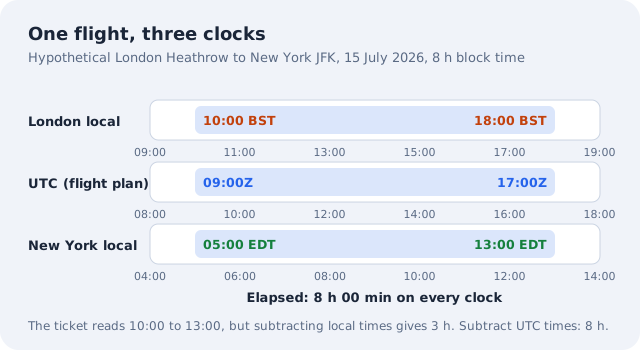
A London to New York ticket says "depart 10:00, arrive 13:00". Behind that line, the airline's systems hold three different clocks: local time at each airport for the passenger, UTC for the flight plan and the airport slot, and elapsed hours for fuel, crew duty and the aircraft. Keeping them consistent twice a year, when clocks change on different dates in Europe and North America, is a routine but real piece of airline planning work.
This guide explains which parts of a flight run on which clock, how the seasonal schedule is tied to daylight saving time, and a worked example of the same flight in four weeks of 2026.
What runs on UTC
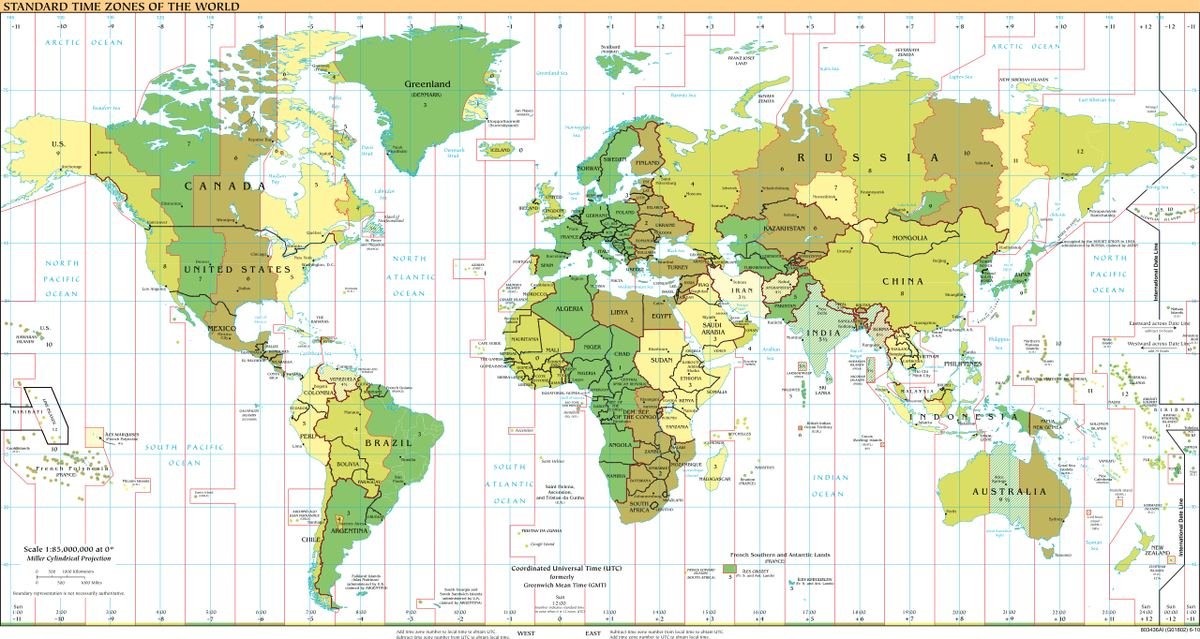
Air traffic control works in Coordinated Universal Time, called "Zulu" in aviation because Z marks the zero-offset zone and Zulu is Z in the phonetic alphabet. A controller in Shanwick and a dispatcher in Chicago refer to the same clock, so nobody has to convert time zones while handing a flight across an ocean. (Our guide to UTC and world time zones explains where UTC comes from.)
The flight plan
An ICAO flight plan does not list gate times and waypoint clock times in local time. It carries two main time fields:
- EOBT, the estimated off-block time (Item 13): when the aircraft is expected to push back from the stand, written as four UTC digits such as
0900. - Total EET, the estimated elapsed time (Item 16): a duration from takeoff to arrival over the destination, such as
0710for 7 hours 10 minutes. Item 16 also names the alternate airports the flight could divert to.
Where a region requires it, Item 18 adds elapsed times to flight information region boundaries, again as durations. The date of flight (DOF/) is a UTC date too. Thailand's aeronautical publication, for example, notes that if a delay pushes departure past 0000 UTC, the operator must send a change message with the new EOBT and the new date of flight.
Airport slots
At busy coordinated airports such as Heathrow, airlines need a slot, a permission to land or take off at a specific time. Slot requests and confirmations are exchanged as SCR messages in the IATA SSIM format, where, as the Swiss slot coordinator's guide puts it, "all dates, days and times are in UTC."
Weather data
Flight planning systems compute routes and fuel from global wind and temperature forecasts produced by the World Area Forecast System (WAFS). Its gridded forecasts are based on model runs at 00, 06, 12 and 18 UTC, four times a day, with steps from hourly to three-hourly out to 48 hours. They are not issued at multi-day intervals.
What runs on local time
Passengers see local times. Tickets, departure boards and published timetables show the clock at each airport, because that is what matters for getting to the gate and catching a train afterwards. The airline's schedule systems store the UTC offset for each airport and date and convert in both directions. The IATA Standard Schedules Information Manual (SSIM), the industry format for exchanging schedules, includes time zone data, and the maintainers of the IANA tz database have long cross-checked their records against IATA's time zone tables.
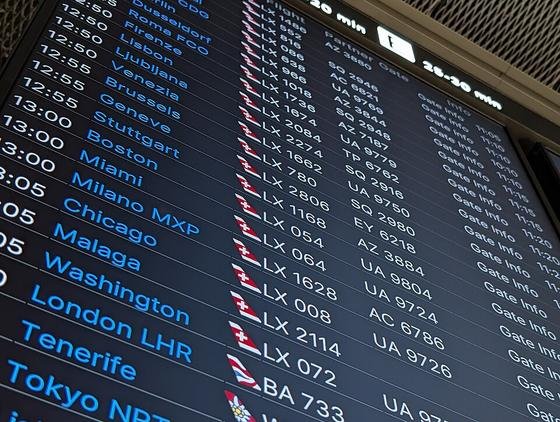
Airport rules are often local-time rules too. Night restrictions are the clearest case:
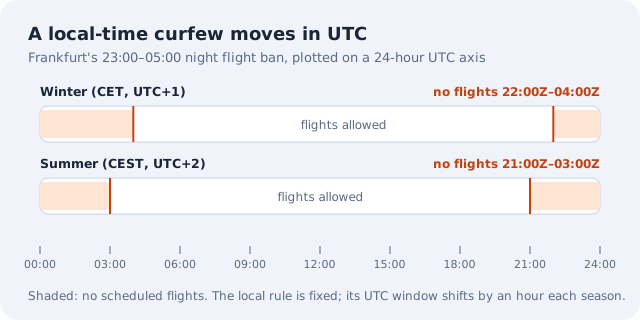
- Frankfurt has a ban on scheduled night flights between 23:00 and 05:00 local time, imposed by the Hesse administrative court in 2011 and upheld by Germany's Federal Administrative Court in April 2012.
- Heathrow does not ban night flights. It has a night quota period from 23:30 to 06:00, with a cap of 5,800 night movements a year (3,250 in summer, 2,550 in winter). Heathrow says no flights are scheduled after 22:55 or before 05:05.
Because these rules follow local clocks, a Frankfurt curfew starting at 23:00 begins at 21:00 UTC in summer and 22:00 UTC in winter. A schedule built in UTC has to move with it.
Two seasons that follow Europe's clock change
Airline schedules are planned in two IATA seasons, and the season boundaries are set to match the European daylight saving dates.
| Season | Rule |
|---|---|
| Summer | Last Sunday of March to the Saturday before the last Sunday of October (7 months) |
| Winter | Last Sunday of October to the Saturday before the last Sunday of March (5 months) |
The next summer season therefore starts on 28 March 2027, the day the UK and the EU move their clocks forward.
Slots for each season are negotiated in advance at IATA's twice-yearly slot conferences: the June conference covers the following winter season and the November conference the next summer season.
Airlines usually want a flight to leave at the same local time all year, so its UTC time moves by one hour when Europe changes its clocks. Since slots are held in UTC, the slot itself has to change. Starting the seasons on the European change dates keeps each season's slots at one fixed UTC time.
Worked example: the same flight across 2026
Take a hypothetical daily flight from London Heathrow to New York JFK, leaving at 10:00 London time with an 8-hour block time (pushback to arrival at the gate). Here is what it looks like on four dates in 2026; the pattern repeats every year. The times were computed with Python's zoneinfo module using the IANA rules for Europe/London and America/New_York.
| Date (2026) | London departs | UTC | New York arrival | Gap |
|---|---|---|---|---|
| Thu 15 Jan | 10:00 GMT | 10:00–18:00 | 13:00 EST | 5 h |
| Sun 15 Mar | 10:00 GMT | 10:00–18:00 | 14:00 EDT | 4 h |
| Wed 15 Jul | 10:00 BST | 09:00–17:00 | 13:00 EDT | 5 h |
| Wed 28 Oct | 10:00 GMT | 10:00–18:00 | 14:00 EDT | 4 h |
Three things stand out:
- Summer moves the UTC slot. In July the same 10:00 local departure is 09:00 UTC, an hour earlier than in January. That is the slot change the IATA season boundary handles.
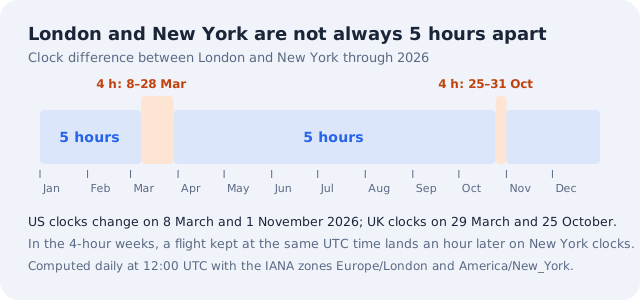
- The mismatch weeks change the arrival time. The US moves to daylight time on the second Sunday in March, the UK on the last Sunday in March. For those two or three weeks London and New York are only 4 hours apart, so an unchanged UTC schedule arrives at 14:00 instead of 13:00. The same happens in autumn for a week, between the last Sunday in October (UK) and the first Sunday in November (US).
- The elapsed time never changes. Fuel, crew duty limits and maintenance intervals all depend on the 8 hours of elapsed time, which no clock change affects.
Block time, air time and why both matter
Airlines distinguish block time, from pushback at the departure gate to arrival at the destination gate ("chocks to chocks"), from air time, from takeoff to touchdown. Timetables are built on block time. It is longer than air time because it includes taxiing, and on congested routes airlines often add extra minutes to the schedule as a buffer against delays. Westbound transatlantic block times are longer than eastbound ones on the same route, because flights heading to North America fly against the prevailing westerly jet stream.
All of these are durations, so they are immune to time zones. Problems arise only when a duration is computed from two local times without accounting for the offset between them. The flight in the example "leaves at 10:00 and arrives at 13:00", but it does not take 3 hours. Taking the difference of the two UTC times gives the true 8 hours.
When a country changes its clocks at short notice
Governments sometimes change daylight saving rules with little warning. For airlines this means updating time zone tables, re-timing affected flights in local time and telling passengers. The IANA tz database records these changes for computers and phones, and the IATA SSIM tables carry them for airline systems. A change announced weeks before it takes effect can leave printed timetables and booked tickets showing the wrong local time. That is one reason operational systems keep everything in UTC and convert to local time only at the edges, when displaying it to people.
If you are planning travel or meetings around a flight, hoyoopin's World Clock shows the current time and UTC offset for 44 cities, including London (UTC±0 right now) and New York (UTC−5), with daylight saving applied from the IANA time zone database. For the exact departure and arrival times of a booked flight, your airline's itinerary is the authority.
The short version
- Flight plans, slots and weather forecasts use UTC. Tickets and airport curfews use local time.
- An ICAO flight plan files the EOBT in UTC and the elapsed time (EET) as a duration, plus alternate airports.
- IATA summer and winter seasons start on Europe's clock-change Sundays, so each season's slots stay at one UTC time.
- Between the US and European clock changes, the London to New York gap shrinks to 4 hours for a few weeks.
- To get a real flight duration, subtract UTC times, not local times.
Frequently Asked Questions
Why do tickets show local times when airlines use UTC?
Passengers need the clock at each airport to get to the gate and plan onward travel. Airline systems store schedules with each airport's UTC offset and convert to local time for tickets, boards and timetables.
What times go into an ICAO flight plan?
The estimated off-block time (EOBT) in UTC, and the total estimated elapsed time (EET) as a duration from takeoff to the destination. The date of flight is also a UTC date, so a late evening departure in the Americas can carry the next day's date.
When do airline summer and winter schedules change?
The IATA summer season starts on the last Sunday of March and the winter season on the last Sunday of October, the same Sundays on which Europe changes its clocks.
Does crossing the International Date Line affect the flight plan?
No. The flight plan and air traffic control use continuous UTC, so the date line does not interrupt anything operationally. It only changes the local calendar date that passengers see on arrival.
Sources
- Night flying restrictions — Wikipedia
- Night flights at Heathrow — Heathrow Airport
- ENR 1.10 Flight planning (EOBT in UTC, DOF and delay messages) — Civil Aviation Authority of Thailand, AIP
- SCR Crash Course (slot messages, times in UTC) — Slot Coordination Switzerland
- WAFS Internet File Service (WIFS) — NOAA Aviation Weather Center
- IATA scheduling seasons and slot conferences — Japan Schedule Coordination