
Why France Has More Time Zones Than Any Other Country
Ask which country has the most time zones and most people say Russia or the United States. The answer is France. Counting its overseas regions and territories, France uses 12 different UTC offsets in the northern winter, and 13 in the northern summer, when Saint Pierre and Miquelon and mainland France move to daylight saving time on different offsets. Add Adélie Land, France's claim in Antarctica, and the counts become 13 and 14.
Here is the full list, checked against the IANA time zone database, along with what it means for anyone working with Paris and the overseas territories.
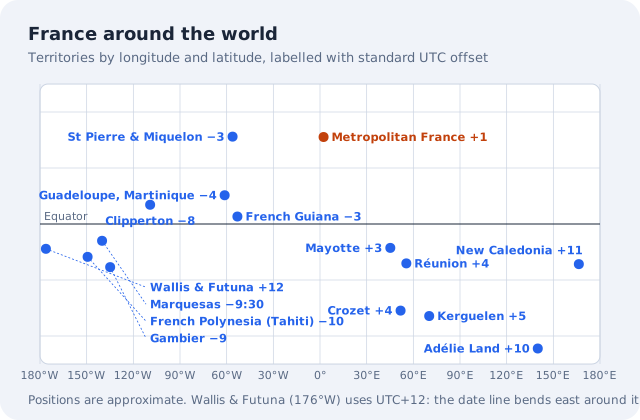
The full list of French time zones
France's territories are spread across the Atlantic, Indian and Pacific Oceans and Antarctica. Each keeps the offset that suits its location. The table runs from the earliest clock to the latest.
| UTC offset | Territories | Daylight saving time |
|---|---|---|
| UTC+12 | Wallis and Futuna | No |
| UTC+11 | New Caledonia | No |
| UTC+10 | Adélie Land (Antarctic claim; Dumont d'Urville station) | No |
| UTC+5 | Kerguelen Islands, Saint Paul and Amsterdam Islands | No |
| UTC+4 | Réunion; Crozet Islands | No |
| UTC+3 | Mayotte; Scattered Islands (Îles Éparses) | No |
| UTC+1 | Metropolitan France, including Corsica | Yes: UTC+2 from the last Sunday of March to the last Sunday of October |
| UTC−3 | French Guiana; Saint Pierre and Miquelon | Saint Pierre and Miquelon only: UTC−2 from March to November |
| UTC−4 | Guadeloupe, Martinique, Saint Barthélemy, Saint Martin | No |
| UTC−8 | Clipperton Island (uninhabited) | No |
| UTC−9 | Gambier Islands (French Polynesia) | No |
| UTC−9:30 | Marquesas Islands (French Polynesia) | No |
| UTC−10 | Tahiti and the Society, Tuamotu and Austral Islands (French Polynesia) | No |
That is 12 offsets without Adélie Land. In summer, mainland France moves from UTC+1 to UTC+2 and Saint Pierre and Miquelon from UTC−3 to UTC−2. Because French Guiana stays on UTC−3, the two summer changes create one extra offset, giving 13. Guinness World Records lists France with 13 time zones on that basis. Adélie Land is usually counted separately because territorial claims in Antarctica are frozen under the Antarctic Treaty.
How France compares
Wikipedia's list of time zones by country gives these counts, including overseas territories:
- France: 12 (13 with Adélie Land)
- Russia: 11, all on one continuous landmass, from Kaliningrad (UTC+2) to Kamchatka (UTC+12)
- United States: 11, counting uninhabited Pacific islands such as Baker Island (UTC−12) and Wake Island (UTC+12)
- United Kingdom and Australia: 9 each, with their overseas or external territories
Russia has the most time zones on a single landmass. France's lead comes entirely from territories far from Europe. Mainland France itself uses one zone.
Who starts the day first?
The French day begins in Wallis and Futuna, at UTC+12, and ends in French Polynesia, where Tahiti is on UTC−10. That is a 22-hour spread. So for 22 hours out of every 24, two calendar dates are in use somewhere in France. Only between 10:00 and 12:00 UTC does every French territory share the same date.
Wallis and Futuna lies at about 176°W, east of the 180° meridian, yet it keeps UTC+12 because the International Date Line bends east around it. Its clocks therefore share the date of nearby Fiji and New Zealand. See how the International Date Line works for the reasons behind those bends.

Worked example: a 9 a.m. call from Paris
A ministry in Paris schedules a video call for 9:00 a.m. on Monday 16 November 2026, after Europe's clocks have gone back. Converted with the IANA database:
- Tahiti: 10:00 p.m. on Sunday 15 November
- Martinique and Guadeloupe: 4:00 a.m. Monday
- French Guiana and Saint Pierre and Miquelon: 5:00 a.m.
- Réunion: 12:00 noon
- New Caledonia: 7:00 p.m.
- Wallis and Futuna: 8:00 p.m.
The same call on Wednesday 15 July 2026, with Paris on summer time, falls at 9:00 p.m. Tuesday in Tahiti, 6:00 p.m. in Nouméa and 5:00 a.m. in Saint Pierre and Miquelon, which has also moved its clocks. French Guiana, which does not change, is now 5 hours behind Paris instead of 4. No single hour falls inside a normal working day everywhere, so offices that deal with all territories rely on split meetings or written handovers. Paris is on UTC+1 today; our Paris city guide shows the live time there and its overlap with other business hubs. For the overseas territories, use a planner that works from the full IANA database.
Why France has so many
The territories are what remains of France's colonial empire. Their status varies. Guadeloupe, Martinique, French Guiana, Réunion and Mayotte are overseas departments and regions, legally part of France and of the European Union. French Polynesia, Wallis and Futuna, Saint Pierre and Miquelon, Saint Barthélemy and Saint Martin are overseas collectivities with their own statutes. New Caledonia has a special status, and the French Southern and Antarctic Lands have no permanent population, only scientific and military staff. Clipperton is administered directly by the government. French Guiana also hosts Europe's spaceport near Kourou, at about 5°N. Its value for launches comes from being close to the equator, where Earth's rotation gives rockets the most extra speed; its UTC−3 clock has nothing to do with it.
Mainland France's own time has a history too. Paris mean solar time ran 9 minutes 21 seconds ahead of Greenwich. In 1911 France adopted Greenwich time as its legal time, and during the German occupation from 1940 the occupied north was switched to German time. France has kept Central European Time, UTC+1, ever since, an hour ahead of what its longitude alone would suggest. For background on Greenwich and UTC, see our guide to UTC and world time zones.
Mainland France runs an hour or more ahead of the Sun
Most of mainland France lies west of 7.5°E, the edge of the area where UTC+1 matches local solar time. As a result, mean solar noon (ignoring the small seasonal wobble of the equation of time) comes late by the clock:
| City | Longitude | Mean solar noon, winter (UTC+1) | Mean solar noon, summer (UTC+2) |
|---|---|---|---|
| Brest | 4.5°W | 13:18 | 14:18 |
| Paris | 2.4°E | 12:51 | 13:51 |
| Strasbourg | 7.8°E | 12:29 | 13:29 |
In Brittany in midsummer, the Sun is highest in the sky after 2 p.m. That is the main reason sunsets in western France come so late in June.
French territories in software
Computers and phones use the IANA time zone database, which gives most French territories their own zone name: Europe/Paris, America/Cayenne, America/Martinique, America/Guadeloupe, America/Miquelon, Indian/Reunion, Indian/Mayotte, Pacific/Noumea, Pacific/Wallis, and three zones for French Polynesia: Pacific/Tahiti, Pacific/Marquesas and Pacific/Gambier. Adélie Land is listed under Antarctica as Antarctica/DumontDUrville.
Two gaps are worth knowing. Clipperton Island, which has no residents, has no zone of its own. And the database uses a single zone, Indian/Kerguelen at UTC+5, for all of the French Southern Lands, so it does not separate out the UTC+4 used on the Crozet Islands. For scheduling with people, that rarely matters, since the only residents there are rotating research and military staff.
The short version
- France uses 12 UTC offsets in winter and 13 in summer, or 13 and 14 counting Adélie Land in Antarctica.
- The range runs from UTC−10 in Tahiti to UTC+12 in Wallis and Futuna, a 22-hour spread.
- Only mainland France and Saint Pierre and Miquelon use daylight saving time, on different dates.
- Wallis and Futuna starts each new day first; French Polynesia is among the last.
- Russia has the most zones on one landmass; the United States, counting uninhabited islands, ties Russia at 11.
Frequently Asked Questions
How many time zones does France have?
France uses 12 different UTC offsets in the northern winter and 13 in the northern summer, when mainland France and Saint Pierre and Miquelon move to daylight time. Counting Adélie Land, its Antarctic claim, the totals are 13 and 14.
Which country has the most time zones on one landmass?
Russia. Its 11 time zones run continuously from Kaliningrad (UTC+2) to Kamchatka (UTC+12).
What time zone is Tahiti in?
Tahiti uses UTC−10 all year, with no daylight saving time. It is 11 hours behind Paris in winter and 12 hours behind in summer.
Which French territories use daylight saving time?
Only metropolitan France and Saint Pierre and Miquelon. Mainland France follows the EU dates in March and October; Saint Pierre and Miquelon follows the North American dates in March and November.
Sources
- Time in France — Wikipedia
- List of time zones by country — Wikipedia
- Country with the most time zones — Guinness World Records
- Time Zone Database — IANA